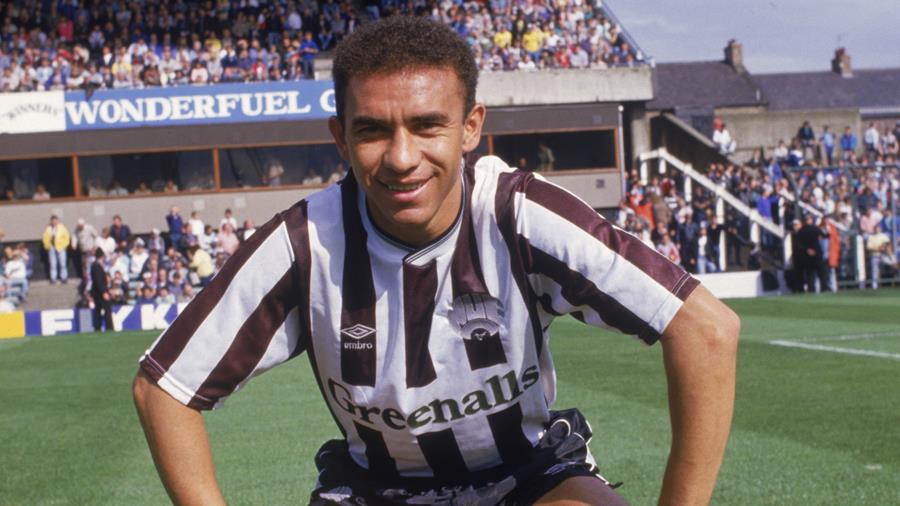
Gallowgate Cult Heroes; Number 4 Micky Quinn

If you’re a Newcastle United fan, it’s almost certain that you’ll love a number 9. We’ve been brought up on them. For the older generation, we would have been told stories of Jackie Milburn, Hughie Gallagher and Len White. Some of us might even have been lucky enough to watch the great Supermac in the 70s. The younger generation could point to the brilliance of the likes of Cole, Ferdinand, Shearer and even Callum Wilson.

No one can argue that we’ve had a glut of quality strikers to have idolised over the years. Even when you move away from the obvious, you’ll still find some excellent strikers who’ve left their mark on Tyneside. Micky Quinn is definitely one of those names and to this day holds cult status in Newcastle.

Quinn was signed from Portsmouth at a turbulent time for the club. Arriving in July 1989 for £680,000, he was joining a fractured club. Many supporters were boycotting the club and protesting against the board of the time which was led by one of the most unpopular chairmen of my lifetime in Gordon McKeag. So while Quinn jumped at the chance to join the Toon, he certainly wasn’t popular from the off. Quinn himself famously tells a story of seeing the protests as he walked through the city and bearing witness to a banner that asked ‘Who the f**k is Mick Quinn?’

I was well aware of who he was as the kind of geeky kid who always kept track of the top scorers in every division, so Quinny’s signing excited me and was a rare piece of good news at a time when I could feel myself drifting away from the club and its under-ambitious ownership. As well as being a Bob Carolgees lookalike, Quinny was known for being a little on the larger side and in truth wasn’t the perfect physical specimen, but as he’d say later on in his career, he was the fastest you’d find over the first yard!

My cousin was part of the supporter boycott and I was torn between getting a ticket for the first game of the season or standing outside St. James’ Park like he did and trying to persuade people to stay away and put pressure on the board. Thankfully, I went in that day.

Quinny’s debut is the stuff of modern NUFC folklore. In front of just over 24,000 fans, he scored four goals in a 5-2 win against promotion favourites Leeds United. By the end of the game, no one was asking who he was anymore and Quinny quickly became a crowd favourite. Having stood watching the likes of Frank Pingel, Mirandinha and Rob Macdonald struggle to score goals in the previous season, I was thrilled that we had such a number 9 as Micky Quinn and for many others he would become a hero just based on that game alone.

Quinny scored 34 goals in that first season, cementing his place in the history of the club and also in the hearts of many a supporter of a certain age. After 4 on debut he then went on to score in each of the next 4 games and he simply kept on scoring all season. His record for that season – 34 in 53 games has him in 5th place for the most goals scored in a season at NUFC. I was 18 at the time and the partnership between Quinny and Mark McGhee that season remains one of my favourites of all time.

In his second season Quinny scored 20 goals, but the team finished 11th in the old 2nd division and the writing was on the wall for manager Ossie Ardiles. The season that followed was the now infamous and almost disastrous one that ended with Kevin Keegan coming in as manager and somehow managing to save us from the drop. Quinn scored 10 that year but was eclipsed by midfielder Gavin Peacock who got 21 and it would become obvious that the manager didn’t really fancy our cult hero.

During that amazing first season in ’89-’90 I was lucky enough to meet Micky. He was part of a group of Newcastle players who were taking part in a charity cricket match at a local cricket club in Swalwell. Me and a couple of mates went along and skulked around on the boundary, waiting to try and grab a word with our heroes. I was 17 and still very much in awe of these people who I watched week in week out.

Having managed to get an autograph from Kevin Brock, we waited and waited for Quinny and when he was fielding right by the rope we grabbed our opportunity. He signed my old green and yellow striped away top and was just a genuinely nice bloke. He’d taken a flying catch moments before and was full of himself, as you would be!

Another, rather different memory of Quinny would be from a couple of seasons later and the 91-92 season. It was away at Sunderland and the infamous Liam O’Brien over the wall game. Quinny was actually injured and on crutches at the time but I have a vivid memory of him approaching the way fans in the Roker End at the end of the game, wildly waving his crutches around and celebrating. We’d had a few crucial injuries going into the game and so the draw was actually a great result and Micky, like the whole away end, was ecstatic. He knew just what the club meant to the fans!

To those of us who followed Newcastle United around the country in the late 80s and early 90s, Mick Quinn was a legend. When he wasn’t banging in the goals he could invariably be found ‘de-stressing’ in the local nightclubs and was a big fan of the Tuxedo Princess! A lot of that side of things is detailed in his excellent autobiography ‘Who At All The Pies’, which is a must read if Quinny is a new name to you.

In all, Quinny scored 63 goals in 126 appearances for the club and always gave everything. He embraced the weight of that number 9 shirt and did it proud, starting with that incredible debut. He was eventually sold to Coventry City where he would go on to gain cult hero status with their fans too. Newcastle United moved on in style when he was sold, with Kevin Keegan bringing in Andy Cole as we gained promotion. A lot of us fans will never forget Micky Quinn though!

The Joys of Volunteering

For the last few months I’ve been trying something a little bit different. It started with just giving my son a lift to where he was going and then curiosity and trying to be a good dad somehow got the better of me. Now, I seem to be a fully fledged volunteer!

In actual fact, the whole thing really started around a year ago. My son had decided to do his Bronze for the Duke of Edinburgh Award and as part of his challenge he had to do 6 months worth of volunteering and so, following in his sister’s footsteps, he started helping out at a local Parkrun. For the majority of the time there were four of them, all friends, doing this. But then occasionally it’d just be him and so I got involved and stood marshalling with him on various parts of the course. Often cold, but always bearable!

When he decided to then do his Silver D of E award we thought he’d change his volunteering to something else. But he didn’t and so here we are again!

For the first few weeks I would just drop him off and then go for a long walk around the country park that the run takes place in. After all, it wasn’t me who was taking part in the Duke of Edinburgh award and besides, I saw my Saturday morning hike as good recovery time, as my heart operation was a few months previous. The exercise combined with that early morning solitude was blissful!

Then, one week my son asked if I fancied joining in and doing some marshalling with him. Having done a few weeks scanning the barcodes of the finishers he fancied a change and so of course, in my quest to be dad of the year, I said yes.

There are loads of different roles that you can volunteer for at a Parkrun. I had a look at our latest roster and that told me that there were 15 different jobs to choose from. You can fulfil various roles at the finish, as well as tail walking with the last participant, be it a runner or walker. And in marshalling alone, we have 11 different checkpoints to fill. So, there’s a lot of variation in what you can choose to be doing in supporting the runners.

As a marshall, all we really do is watch the runners come past our checkpoint, keep an eye out for any problems, answer any questions and make sure no one walks across the course as the runners approach. Oh, and clapping. We do a lot of clapping and encouraging.

Of course, it’s been winter and so the conditions have been cold, to say the least. The standing around doesn’t help either and in fact it can leave me in a bit of pain as my back and my feet don’t seem keen on just standing. A couple of weeks ago we were soaked to the skin, despite wearing heavy coats, as the rain was just torrential. But the race went on! It made me look forward to Spring and the weather being a bit warmer though!

Volunteering always leaves me in a good mood. For a start, there’s the sense of pride that you get in just being able to help out. It’s nice that lots of the runners will actively thank us as they go round. I always think it’s nice to be appreciated, even though it feels strange to be thanked when the runners are the ones exerting themselves! But at a time when my mental health hasn’t always been good it’s a welcome boost.

It’s nice to feel like part of something too. There’s a friendliness and a sense of community amongst both runners and volunteers and although I’m quite quiet and don’t really talk to too many people, it always feels like we’re welcome and very much appreciated. And of course it’s good to spend some quality time with my son too, despite the early mornings!

In the future, perhaps in retirement I’d like to do more volunteering. We’ve talked about helping out at one of the RSPB reserves as it’s something that’s been of interest for a while. I’d like to volunteer with the homeless too. I think that given I’ll have a bit more time to play with once I’m retired or at least semi retired, it’d be good to use that to help others.

In the meantime, volunteering is something that I’d actively encourage anyone to try. It can get you exercise and undoubtedly helps with your mental health. The fresh air alone is really important to me.

If you’re thinking of volunteering, there are over 1200 different Parkruns around the U.K. It’s easy to do, even if it is quite early on a Saturday or Sunday morning and the rewards are great. I can’t guarantee the weather, but it’s something that I’d definitely recommend. Give it a go, it might just make a really positive change in your life!

Middle Age Gigging: Noel Gallagher’s High Flying Birds at Leeds First Direct Arena.

As a child of the 70s and 80s, I sometimes get to thinking that there have been times when I’ve had very little to feel lucky about. Growing up in the North of England I watched heavy industry being torn apart, mass unemployment, a decidedly average football team and all things Margaret Thatcher for around about the first 20 years of my life. It all felt a bit rubbish, to be honest!

However, there was always music, even if that invariably meant mining the past to listen to more of bands like The Beatles and The Rolling Stones. And then, in the mid to late 80s came The Smiths and The Stone Roses amongst other followed in the early 90s, by Oasis. They were right up my street, I was the right age and thanks to the fact that attended a university in the north west, I was in the right place too. Sadly, all good things come to and end and thus the brothers Gallagher eventually went their separate ways, Liam forming Beady Eye and Noel bringing together his High Flying Birds. They would leave a legacy of incredible music and a lifetime’s worth of memories though.

Oasis and the Gallaghers have been a huge part of my musical life ever since and so tonight, despite the time of year and another hard day at work, I’m tingling with excitement at the prospect of watching Noel Gallagher’s High Flying Birds at Leeds Arena.

The band/Noel have an album to promote, June’s ‘Council Skies’, and have been on tour worldwide for months. We last saw them in Leeds 7 or 8 years ago, so tonight is highly anticipated and walking through the city on the way to the venue the atmosphere gets better the closer we get. There’s a definite buzz, which although is probably partly due to Christmas, intensifies as we near the venue and by the time we take our seats with around half an hour until stage time you can sense that everyone feels exactly the same. Everyone is up for this!

As a middle age gig goer it’s quite comforting to see the age profile of the crowd. In short, there are plenty here around my age and plenty more who look decidedly older. And I have to do more than a few double takes at the amount of families who’ve turned up. Who know that so many teenagers love a bit of Noel?!

With what must be 5 minutes still to go until stage time the lights dim and we’re greeted with a kind of white noise. The screen behind the stage is fuzzy, but as the noise intensifies the blur clears and five minutes later with a backdrop that now reads ‘Noel Gallagher’s High Flying Birds’ the band amble onstage to a heroes’ welcome.

Opener ‘Pretty Boy’ is a personal favourite from the new album, so I’m immediately onside. It’s a blinding version too. Next up is ‘Council Skies’ followed by the brilliant ‘Open The Door, See What You Find’ and three tracks in – all from the new album – the Leeds Arena is rocking!

It’s only at this point that Noel finally speaks, finding just enough time to remind us that he’s a Man City fan (I mean, you would, wouldn’t you?!) and say good evening to Leeds before the band launch headlong into another couple of tracks from the new album, ‘Council Skies’ in ‘We’re Gonna Get There In The End’ and ‘Easy Now’, both of which are excellent. Being notoriously bad with even the lyrics of songs that I’ve been listening to for years, I’ve bumbled my way through this section by joining in with most of the choruses and the odd line here and there, but I’m still having a brilliant time. Noel has just always had a happy knack of being able to churn out amazing tunes. Furthermore, this being an arena gig, we’re sitting down meaning that the middle age knees are having a much needed rest!

The High Flying Birds then raid their back catalogue with five older songs, featuring classics ‘In The Heat of The Moment’, ‘If I Had a Gun’ and a raucous ‘AKA…What a Life!’ before most of the band leave the stage while Noel and long time keyboard player Mike Rowe perform a beautiful version of ‘Dead in The Water’.

Having earlier promised us a “trip back to the 90s” Noel and the band now head further into his back catalogue. It’s time for some Oasis tunes!

Starting with the beautiful ‘Going Nowhere’ we’re then treated to ‘The Importance of Being Idle’, the always amazing ‘The Masterplan’ and ‘Half The World Away’ before the set closes with a superbly noisy and spirited version of ‘Little by Little’.

Undoubtedly, at least three quarters of tonight’s crowd were there in the 90s with Oasis and so, despite the creaking knees, the greying hair and the almost permanent aching back – I’m throwing everyone in with my own symptoms here – hearing those songs live again is quite the experience and as much as we love Noel’s newer stuff, the Oasis tunes will always hold a special place in our hearts.

Within minutes of leaving the stage, the band are back for the encore. Noel, who’s gotten more chatty as the gig has gone on, jokes about the next song; we’ll all know the chorus but only him and Bob Dylan know the verses! He might be right too and as he plays a cover of Dylan’s ‘Quinn The Eskimo’ I’m transported back to the late 80s and chanting the chorus on the terraces at Newcastle United in homage to our number 9, the goal machine Micky Quinn!

Next up is ‘Live Forever’ and more special memories. It’s a stunning version of the song and as it’s one I used to sing to my wife in the early days of our relationship, I’ll confess to a little bit of a tear. I hope Noel would understand! And of course, this is a huge part of the point of tonight for a lot of us. We’re rolling back the years, loving every moment of the hour and a half that we get to spend with one of our musical heroes and remembering what were special times when we were a lot younger. And the man in front of us played a big part in changing the landscape of music.

Tonight ends with the stone cold classic that is ‘Don’t Look Back in Anger’. Everyone is up out of their seats and those standing at the front of the arena are now just a swaying mass of bodies all hands held aloft and no doubt singing back every word at the top of their voices. It’s the same all around the arena. It’s been a staggeringly good gig. The band are just superb and Noel has been on top form.

By the end, I’m knackered but blissfully happy as only the opportunity to hear a bunch of songs that mean so much can make you. Noel Gallagher’s High Flying Birds have been perfect and I’m pretty sure that every last one of us would agree. Noel, if you ever get to read this, thanks for another brilliant night…and thanks for the memories. May we all keep making them for a good few years yet!

Looking to the future – Newcastle United Under 19 v AC Milan Under 19

Newcastle kicked off their final UEFA Youth League game yesterday knowing that it would be their last for a while with opponents Milan already assured of top spot in the group.

As someone who is only able to catch the odd academy or reserve game, I was interested to tune in and see just what the future might have in store for Newcastle fans though. And given the level of opposition and the competition, this one was particularly intriguing.

There was a very early change for Newcastle as Ciaran Thompson was replaced having gone down with a head injury after an aerial challenge in the first 20 seconds. It almost immediately looked like it was going to be one of those days as just with the first team, injuries were now happening freakishly and taking their toll of the youngsters.

And it got worse. Milan opened the scoring on 8 minutes as right winger Liberale cut in on to his left foot and hit a speculative curler, which bounced just as it reached keeper Adrian Janusz and somehow squirmed into the net. It may well have taken a nick of a defender, but really the keeper will be only too aware that he could have done better.

While our youngsters could have sunk without trace against such quality opposition, what happened next showed a lot of courage. Newcastle grew into the game as the half went on. We had lots of the ball and it was noticeable how quickly we tried to get it forward, often going direct into the channels and getting Milan turned.

As the half progressed we seemed to settle nicely, building well from the back and moving the ball skillfully through midfield. It just didn’t want to stick up front though, despite the best efforts of Jonny Emerson and Ben Parkinson. With Milan already through to the next stage of the competition and having made numerous changes to their line up, Newcastle had nothing to lose and it was good to see them growing in confidence as the half drew to a close.

In the second half, Newcastle continued to dominate the ball, but the renewed effort and crisper tackling saw them really take hold of the game and they proceeded to pop the ball around with confidence.

It wasn’t long before their efforts were rewarded as Cathal Heffernan won a header from a corner which dropped at the feet of Travis Hernes who swivelled well and scored from close range. That was on 51 minutes and within four more United had taken the lead.

This time it was Heffernan with the goal. A free kick was curled over and when it was only half cleared to the edge of the box, sub Leo Shahar nodded it forward where Heffernan was waiting to hold off his marker and drill the ball home with a finish that Shearer would have been proud of!

From then on it was pretty much all Newcastle as we controlled the ball and managed to keep Milan at arms length. There were several forays forward from our youngsters and it was great to see the side playing with such energy and confidence.

Amazingly, the young Magpies extended their lead and essentially put the game to bed, on 73 minutes. And it was a lovely move as the ball was worked out of defence via Charlie MacArthur, eventually finding Ben Parkinson who’d dropped deep into midfield. He turned quickly and drove forward before switching the ball to the right edge of Milan’s box. Good work by sub Shaun Neave saw him beat the full back and get to the byline before pulling the ball across the face of goal to find Parkinson, who carried on his run unopposed and was able to steer it home for the goal.

Newcastle were able to see out the game fairly comfortably, keeping Milan at arms length and controlling the game with a real confidence. Ben Dawson could often be heard telling the lads to ‘look after the ball’ and that’s exactly what they did. The final 3-1 scoreline couldn’t really be argued with.

For me, there were a few standout performances. At the back, Heffernan and McArthur look pretty solid. Both are comfortable on the ball and read the game well as well as having a solid physical presence and it wouldn’t be a great surprise to see them as first teamers in the not too distant future. Also in defence, Leo Shahar stood out, using the ball well and dealing well with Milan’s forward players. At only 16, he looks a real prospect. I thought Jonny Emerson and Ben Parkinson looked good too, holding the ball well and driving Newcastle forward. Parkinson’s goal was particularly impressive.

The two who really caught the eye though, were Travis Hernes in midfield and Trevan Sanusi who played wide on the left. Hernes was brought in from Shrewsbury in summer and looks very comfortable on the ball. He’s a big lad, so deals well with the physical side of the game, but possesses a decent turn of pace too. A classy, ball playing midfielder who at times reminded a bit of Jude Bellingham, not to put too much pressure on the lad. I feel sure he’ll be a first team prospect in the near future and is definitely one to watch.

Then there was Sanusi who looks a lad with a big future. Trevan looked confident on the ball and extremely skillful. There were times when he turned his full back inside out, which for a 16-year-old at this level is very impressive. He’s another with a real turn of pace too and certainly seems like the kind of player who’d get a St. James’ Park crowd off their seats given half a chance.

In all, an enjoyable match and a great result. Newcastle’s youngsters dominated for much of the game and deserved the points. Without wanting to put too much pressure on these boys, it looks like we might have a very bright future on our hands.

The Alternative Christmas Playlist

It’s that time of year again. The festive period is well and truly upon us – in fact for some people it’s been with them since the start of November. This means a lot of different things, from office parties to buying last minute presents at the local 24 hour garage, but one of the best things has to be the music.

I must confess that despite feeling of sadness I get as commercial organisations bring Christmas further and further forward each year, I’m a sucker for a Christmas tune. So while I might well grumble at the Christmas decor in the supermarket at the end of October, I’ll soon find myself singing along to anything from Slade to Shakin’ Stevens. I’ll probably even give a grudging whistle along to Mariah Carey, if I’m honest. Christmas can have a funny effect on us after all.

As good as I find Christmas music, by the time you’ve heard it on repeat in every shop you visit for even a few days, you’ve possibly heard enough. So, rather than bang on about the kind of Christmas songs that we’ve heard a million times before, I thought I’d give a mention to some that are perhaps a bit more hidden away and some that you might not have heard before. That said, while I’ve put together an alternative list, there are some that still sit firmly in the mainstream. But, although you’ve probably heard them a lot over the years, they’re still well worth a mention. Which leads us nicely into my first choice…

Fairytale of New York by The Pogues featuring Kirsty MacColl. This one’s become even more poignant with news of the death Pogues singer Shane McGowan, but it was always a classic. If you haven’t heard this track, then put simply my friend, where have you been? Whether you consider this part of the mainstream or actually still a bit alternative, it deserves to be on any list of Christmas songs to listen to. What starts off as a melancholic ballad, quickly morphs into a stomping folk tune as the tempo is upped and the band present their own version of a Christmas song. Fairytale of New York reminds us that while Christmas is a time for peace and goodwill to all men, that’s not always possible. Just go on a works Christmas ‘do’ if you need to find out! In recent years the lyrics have come under scrutiny and have been criticised, for their swearing and slurs and a radio friendly, sanitised version is available. But for me, while some winced at the insulting nature of some of the lines – there’s even a homophobic slur at one point – the original, swaggering, sweary version of the song will always be the one I play and sing. Nick Cave called it “the greatest Christmas song ever written” and do you know what? He’s right!

I Was Born on Christmas Day by St. Etienne and Tim Burgess. A proper Christmas banger, this one! St. Etienne were one of my favourite bands in the 90s and were purveyors of what I’d call perfect pop. Well crafted, melodic pop songs were their thing and Sarah Cracknell’s voice was just wonderful. They’re joined by Tim Burgess of The Charlatans on this one and it’s a real festive winner. Upbeat, catchy and featuring some lovely Christmas bells, this is definitely one to brighten up your Yuletide. And for added fun, check out the band performing it on Top of The Pops with Tim looking ever so slightly tipsy!

As The Snowflakes Fall by Smith and Burrows. This is a from a Christmas themed album called Funny Looking Angels that contains Christmas songs and covers with a hint of Christmas about them. It’s been my go to record at this time of year for a good while now and I could have chosen any track from it. However, I went for something a bit different in ‘As The Snowflakes Fall’. It’s a bit of a waltz really, with a shuffling rhythm and some beautiful harmonies and the song has more than a hint of Elliot Smith about it. So, if you like melodic, folksy type stuff, then this will appeal. To be honest though, I’d thoroughly recommend the entire album…it might just change your life.

Christmas Was Better in The 80s by Futureheads. Starting off with the feel of a traditional Christmas hymn, almost, this one swiftly morphs into just what you might expect from the Futureheads; a post punk, cleverly written romp of a tune. A punk love song to their beloved childhood this one promotes a time when everything seemed better. Life was easier when you could go to bed early and wake up to a pile of presents. With much to sing along to, this is a Christmas track that’s very much worth a listen.

Corpus Christi Carol by Jeff Buckley. A bit of a vocal masterpiece, this one. As you’d expect with the wonderful Jeff Buckley this is truly beautiful. Corpus Christi Carol though is an actual carol from the middle ages. So, if you’re looking for something a bit more traditional on your playlist, then this should appeal. Buckley’s version is stripped right back; just his incredible voice – and he gives a truly stunning performance here – and a guitar, which makes this really quite haunting. So, while this isn’t going to make you feel the same kind of festive spirit as say Slade or Roy Wood and Wizard, it will definitely warm your heart.

Two Thousand Miles by The Pretenders. Another classic and not altogether an alternative pick, but definitely not your everyday Christmas fodder either. This one is about being separated from your loved one at Christmas, hence the title. So, while it’s a Christmas song, it’s certainly not traditional in its content. I suppose it’s highlighting that Christmas is a time for being together, so being apart from the one you love makes it all the more difficult. A beautiful tune though. A great showcase for Chrissie Hynde’s vocals as well.

Just Like Christmas by Low. Another one that’s tinged with sadness, while at the same time being a track that you’ll find yourself singing along with quite cheerily, especially the chorus. With it’s shuffling rhythm and Christmas bells it’s a definite toe tapper and there’s even a little instrumental break in the middle that always reminds me of The Love Cats by The Cure. Although the lyrics get a little bit morose – apparently it wasn’t like Christmas at all – this is definitely a tune to check out with its references to a snowy winter. And it always reminds me of the band First Aid Kit, which is all the more reason to check it out.

Christmas Time (Don’t Let The Bells End) by The Darkness. After a slightly down beat couple of tracks we definitely need a mood change. So what better than a bit of Christmas tinged hair metal? This tune is just an absolute romp, complete with trademark falsetto vocals, riotous guitars and a healthy smattering of humour. With its brilliantly singalong chorus, you’re on to a winner with this and maybe just a little bit of a Christmas drink!

Winter Song by Lindisfarne. I’ve sort of shoehorned this one in as it’s not strictly speaking a Christmas song. However, Lindisfarne being from Newcastle has helped its inclusion, along with the fact that it’s actually really good. This one draws on the band’s memories of winters in the North East of England which can often feel long, dark and bloody cold. There’s a vulnerability to Alan Hull’s voice here that is somewhat perfect for the slight hint of bitterness of the song. Anyway, it’s just brilliant, so give it a listen!

Last, but not least…Wonderful Christmastime by The Shins. This is just a wonderful cover of the Paul McCartney classic by American indie legends The Shins. You’ll know the original, but now say hello to this brilliant cover. There’s almost a Phil Spector style ‘wall of sound’ quality to this one at times, yet at others it’s really quite stripped back. As a fan of the original, I was surprised how much I enjoyed this cover when I first heard it. I think you’ll enjoy it too!

So there you have it. A Yuletide Top 10 of alternative Christmas classics. I hope you’ll search them out as they’ll come in handy as an antidote when you’ve had just a bit too much of the usual stuff!

Gallowgate Cult Heroes; Number 3 Imre Varadi

When I first started writing this series, I wondered how far back I’d be able to go. I’m trying to write more about players that I actually saw play, rather than just delving into the history books – and Wikipedia – and providing you with a list of stats. So, in essence I’m restricting myself to going back as far as the late 70s at best and even then, my memory won’t always be reliable.

The third player in the series is one that I only just remember, as well as being one of my first ever black and white heroes.

Imre Varadi was signed, with not a great deal of fanfare from Everton in the summer of 1981. A 22-year-old Londoner, with a Hungarian/Italian background, he was brought in by manager Arthur Cox to help solve what had become a major goalscoring problem. With the previous season’s strikers – the likes of Bobby Shinton, Alan Shoulder, Mick Harford and a young Chris Waddle – struggling to find the net, Varadi faced a challenge. However, he must have felt that he couldn’t really fail, given that the previous season’s top scorer had been Shinton with 7 goals. And so, a memorable, but brief chapter began.

Newcastle were languishing in Division 2 (now the Championship) at the time but in his first season (81/82) Imre scored a commendable 20 goals in 47 appearances. However, it took him a while to actually find the net. When he did eventually did though it was spectacular as he bagged a hat-trick in a 0-4 away win at Cardiff. Suddenly, things were beginning to click into place. In the next game, this time at home to Derby he scored a brace in a 3-0 home win.

Varadi had electric pace, an eye for goal and was more than capable of an eye-catching piece of skill. He was unpredictable and brave, doing the number 9 shirt proud. It was easy to see why a success starved Gallowgate would take to him so quickly. But things were about to change on Tyneside.

In the summer of 1982 Newcastle United grabbed the football world’s attention by signing the England captain Kevin Keegan from Southampton. How we’d managed to sign the twice Ballon D’or winner is anyone’s guess, but we did and he would go on to help change the history of the club. It was the beginning of the end of Varadi though.

The season started well, with Varadi providing the assist for Keegan’s winning goal in the first game of the season at home to QPR. In goalscoring terms though he made a slow start. While strike partner Keegan scored 3 goals in his first three games, Varadi didn’t score until the sixth week of the season.

However, by the end of the season he had scored 22 goals in 43 appearances and was again a roaring success as he finished as top scorer. Keegan himself only made 16 league appearances, scoring 21 goals and was rightly idolised. And this was possibly what would cost Varadi. Newcastle, having finished 5th that season went all out for promotion the next, signing John Ryan for a then club record fee of £250k, David Mills and a 22-year-old called Peter Beardsley in the summer with Imre being sold to Sheffield Wednesday for £180k.

I remember rumours about Varadi’s relationship with Keegan at the time and since then have heard the same type of things mentioned time and again in relation to his departure, but I really wouldn’t know. Whatever the reason, it seemed a strange move to get rid of the top scorer of the previous two seasons. Varadi scored goals and was popular with the fans and yet was still sacrificed to a rival. Mind you, Keegan would do the same himself as manager, years later, with Andy Cole, ending up explaining himself to confused and angry fans on the steps of the Milburn stand.

Imre Varadi was the first number 9 that really captured my imagination. I wasn’t old enough to remember Supermac and there’d been precious little else to grab on to during my fledgling years as a Toon supporter. I remember being enamored by Peter Withe, but even then I was only 6! My other favourite player had been midfielder Micky Burns, but there was nothing that excited me as much as Varadi did when he signed. I knew nothing of him, but that first hat-trick had me hooked! I’d fallen in love with a club that felt like it gave precious little back, but when Varadi got the ball and ran it felt like there was a bit more of a point being there.

With 42 goals in 90 games, Imre Varadi had a decent strike rate and was the kind of striker that excited the fans. But with a young Chris Waddle coming through and Peter Beardsley set to make an amazing impact with Kevin Keegan, maybe letting him go was the correct decision. By the end of his career he’d become very much a journeyman pro, ending up with 17 clubs in all, so perhaps his two years with us was par for the course.

In recent interviews, Varadi has expressed great love for his time with Newcastle and for a couple of years, there were a fair few of us who loved him right back. But cult hero or not, nobody could really compete with King Kev, could they?

Book Review: ‘Don’t Need The Sunshine’ by John Osborne

I’ve always loved the seaside. Newcastle, where I was brought up, is close to some of the best coastline that the UK has to offer, so there was always an easy access day trip whenever one was needed. We’d spend entre days there as kids during the summer holidays. Further to that, being born into a family that placed a high value on the power of a bracing walk meant that windy beaches were our regular stomping grounds. In fact, we went every year on New Year’s Day as a family tradition!

So, it was a pleasure to read this book, as well as a nice trip down memory lane. John Osborne’s ‘Don’t Need The Sunshine’ is a celebration of the charms of the British seaside and when I caught sight of the cover and two primary school aged kids in decidedly 70s clothing eating ice creams at the beach, I was always going to buy it. And it proved to be money well spent.

While working in Scarborough for a summer, Osborne is struck by a feeling of nostalgia for the traditions of the British seaside. And so begins an often rainy odyssey of trips to a variety of UK seaside spots.

John’s trips begin in Scarborough, which if you aren’t aware, is a classic British seaside town. A long, sweeping sandy beach, a harbour, gift shops, amusement arcades and various bars and pubs dominate a town where thousands flock in summer in search of seaside fun and entertainment. These days it’s slightly run down, although still a great destination for a few days at the beach, but Osborne finds much evidence to support the fact that the nostalgic activities he remembers from childhood are still very much in play in Scarbs.

From Scarborough, Osborne journeys down and around the country taking in a variety of seaside destinations. I was really disappointed that none of my old North East haunts were visited, but with such subject matter you’re never going to please all of the people all of the time, given the sheer amount of coastline that we have on our little island. That said, a chapter on Whitley Bay or Tynemouth would have been much appreciated!

There are various tales here though. From historical tales of Skegness to the arcades in East Anglia, following the suicide watch at Beachy Head right through to the ‘ultimate’ sandcastle competition and a remote western lighthouse. The British seaside provides Osborne with a wonderful collection of experiences to immerse himself and the readers in, as well as a selection of wonderful people to spend time with.

The result is a fascinating read. It might be quite a niche subject and possibly of much more appeal to us Brits than anyone else, but I’d still thoroughly recommend it.

‘Don’t Need The Sunshine’ provides a wonderful dose of nostalgia about a slightly faded British institution. Millions of us grew up looking forward to days out at the seaside; some of us still do. But the typical British seaside town has changed immeasurably from what we’d see in their heyday. The rise of first the package holiday in the 60s and 70s and then budget airlines in the early 2000s signalled a death knell for many of our resorts. However, the popularity of ‘staycations’ mean that they are making something of a comeback. Still, most of what Osborne finds just isn’t the same.

That said, he finds joy and hope in most of the places that he visits. Sometimes, it’s nostalgia based, sometimes it’s fleeting, but it’s joy all the same. And that’s the thing about the British seaside; there’s always at least a sliver of joy to be had. It’s just that sometimes you have to take a little more time to look.

Osborne’s writing is excellent. As he describes the people and places that he finds on his trips, you’re transported there with him. He’s sympathetic to the plight of our seaside towns so that everything has a positive outlook and while it doesn’t serve as some sort of propaganda, the work that’s going on is highlighted and praised appropriately. The resorts are treated with a genuine affection as Osborne reveals that when you scratch beneath the surface there’s a lot going on in our seaside towns. He clearly loves them, like a lot of us Brits still do. And that’s what makes ‘Don’t Need The Sunshine’ such a great read. Osborne’s subject matter has something for everyone; whether your ‘of a certain age’ like me and looking for a trip back in time to a different age and time or you just live a long way from the seaside and only take trips there ever so occasionally.

It would have been easy to write a book that was sniggering, cynical and sarcastic about the UK’s seaside towns. But thankfully that hasn’t happened here. Instead, ‘Don’t Need The Sunshine’ emphasises the positives and the diversity that you’ll find, touching also on the glamour of the past. And I for one absolutely loved it!

I give ‘Don’t Need The Sunshine’

Rating: 4 out of 5.

The Pacemaker Diaries – One year on…

So it turns out that last week had a number of big days. Huge, in fact because last week marked a year since I had my pacemaker fitted.

I remember it well. Of course I do. At the beginning of that week I had realised that I was seriously ill. Even then, I didn’t know what the problem was – but it had been going on for months – and when I was admitted to hospital I still just thought they’d keep me in overnight and send me home with some tablets that would miraculously make everything alright again. My heart wouldn’t keep me awake at night. There would be no more listening for it and wondering if it had stopped.

The morning came and a lovely cardiologist disappointed me with his lack of tablets, then stunned me with his talk of a pacemaker. Despite protesting – “those things are for pensioners, man” – I was very quickly put in my place. “Put it this way, your heart stopped for over 4 seconds last night.” The other option was not to do it, but to lose my driving licence and then start worrying about my job. After all, it’s not normal or safe to be blacking out left, right and centre and I was told that this was likely.

“I think we’ll fit that pacemaker then!”

I laughed about it but I was crying inside. I was far too young for this. And I didn’t have a clue what it actually meant. At least I felt safe in the hospital, but it was a lot to take in. Still is.

The next day, just after 11am, I was wheeled down to theatre, talked through what was going to happen and then they just got on with it. The whole place was calm, jovial even. I was terrified. But do you know what, the more people singing along to the radio while performing your heart surgery, the more comforting it gets!

Later, back on the ward, there was the kind of drama that you never expect to be involved in, as my pacemaker failed and my heart monitor set off every alarm within a five mile radius. At least it felt that way. My heart decided it was time for yet another episode and the palpitations started with a vengeance. Doctors and nurses crowded around my bed, assuring me that help was on the way while I watched a monitor until my heartbeat hit 209bpm. At that point someone took the sensible decision of moving the monitor out of my eyeline.

It turned out fine. Someone from the cardiology department fixed it all online and in as much of a matter of fact way as was humanly possible. While I felt like I was quietly awaiting the grim reaper or a lovely warm light or whatever death looks like (various deceased comedy legends welcoming me ‘home’ and saying they’re my biggest fans?), him and his machine had “a chat with” my pacemaker. It worked.

The next day I was released back into the wild, not really knowing what awaited me. In truth, I didn’t really know if I could make it to the car without stopping for a rest. I imagined though that it might mean a couple of weeks off work. It was four months later that I finally went back.

It’s been a weird year. In some ways I feel worse than ever. It definitely did something to me, mentally and I do find it difficult to motivate myself. On the other hand though, I’m running regularly and actually feel fitter than ever. There have been three 10k races in the last 6 months or so and I feel like I’ve proved a bit of a point to myself. I’m still not quite convinced though.

I can feel my pacemaker every day. When I put on deoderant or have a wash, it’s there. Sometimes, I catch it a bit and it hurts. Occasionally, when I’m carrying a box or something of any decent size, it might rebound on to my chest and boy does it sting! The wires sit there, just above my scar and the pacemaker and they’re right there, just underneath the surface of my chest. Place a finger there and it’s almost like you could pluck them out with a little bit of effort. Not that I’m encouraging anyone to try! I think this is a consequence of me not being very well built; another reason to curse my body! And if you look closely, through my lustrous chest hair, you can actually see the outline shape of the pacemaker itself. How attractive!

There have been no more scares though. No more lying awake at night listening to my heart and wondering what it’s doing. So, the pacemaker is actually a comfort. My heart works which is rather nice.

For a long, long time I was fatigued. I felt like I’d never get better or feel like myself again. My body seemed to take an age to come to terms with what had happened. Coming off beta-blockers helped, but didn’t solve it. From my third day back at home I was going for a daily walk. At first, it was just 10 minutes, but being as bloody-minded as I am I worked that upwards as quickly as I could. But I’d be capable of very little else once I was done and days would simply drift past. Months later, when I felt capable to run a short distance, it would take the rest of the day to recover. In short, for months I just felt terrible. My body ached and I generally felt exhausted. I’d be out of breath easily and immensely frustrated by this.

It’s really not an exaggeration to say that this last year has been a real battle. I’ve felt incredibly low at times – and still have periods like that to this day – and I’ve had to work really hard to keep myself going. I’ve suffered with terrible bouts of sadness, that I didn’t imagine would be possible for me; not just feeling sorry for myself, but genuinely feeling sad, tearful and lonely about life and how things were turning out. The pacemaker made me angry and in truth, I still can’t get my head around the fact that I have to have it.

I regularly remind myself of how lucky I am though. It’d be too easy to just sort of give up and feel sorry for myself. I was almost discharged from hospital before I’d even got to a ward. Only a last minute check showed any kind of problem and only when a senior cardiologist had looked at it all properly was it decided that I had to have a pacemaker. I was actually minutes from going home, so who knows what could have happened? Clearly, I’m lucky though. I’m still here, my quality of life is good and although there are still one or two flutters with my heart now and again, I’m fairly confident that my pacemaker has it all covered!

What I’ve learnt over the course of the last 12 months is that it’s going to take me a while to recover fully and to feel like I’m back to my normal self again. I was ill for months before I got treated – my own fault because I hid what was wrong. But I think that has taken its toll. As I said earlier, I still struggle mentally but I don’t have as many low periods as before. Normal life with work and everything else has helped. But I’ve learnt that I really do have the strength to come back from adversity. Maybe, in another year’s time I’ll have consigned pacemaker diaries to the back of my mind. Maybe.

Hopefully, the future is a bit happier and healthier! Maybe I’ll get to change my tune and write about that instead!

Leave a comment

Middle Aged Gigging – ‘Embrace’ at Leeds O2 Academy…on a school night!

I’m quite sure that nothing can make you feel older or more middle aged than a night out. Not a party with friends or meeting people you know for whatever it might be; no, a night out. In public, with people that you have little or no knowledge of beforehand. Going to a gig is a prime example of this. Thursday night at Embrace was no different for a couple of reasons!

As is now usual, we get to the Leeds Academy early. Having had heart surgery last year, the barrier offers protection for this paranoid old fella, so it’s become our home from home at gigs. However, beyond the comfort, you can never resist a look round and tonight when I do, I’m greeted by a very definite feeling that the usually familiar middle aged audience at an Embrace gig has been infiltrated by…youth! Not even a smattering. Tribes of the buggers, pockets of them everywhere you turn. As I said, there’s nothing that can match their power in making you feel old. And it’s not long before it gets worse.

Within minutes support band The Slates take to the stage. Immediately I’m thinking, ‘I could be all of your dads’. They’re sooo young! And yet, from the first chords of the opener tonight, I’m nothing but impressed. The energy is brilliant and you can’t help but root for these lads. The sight of them does remind me that I have to teach my Year 10s first thing in the morning though. Regardless, their set just makes me smile. Stand out tracks would be ‘What Have You Done?’ and ‘Hello, don’t you know’?, but in truth it’s all impressive from The Slates who look and sound like a band with a bright future ahead of them, even if they do make me feel ancient.

The Slates

There’s a hint of early Arctic Monkeys in there and you can hear the Britpop, but there’s also some ska at times, which given their age and the era of music that they must have grown up with, brings to mind the influence of The Ordinary Boys. Whatever their influences, it doesn’t really matter. The Slates are excellent tonight and they throw themselves into this gig, clearly enjoying their moment. Subsequently, it’s infectious and I’m sure that they’ll leave with more than a few more fans tonight. I’ll definitely be searching out their music.

After a quick shuffle around of equipment on stage it’s time for another support act; Tom Speight. The energy is certainly no less, but it’s different. Tom Speight is, as the name suggests, a solo artist, although he is backed by another singer, a girl who I think he called Hedara who had a great voice (apologies though if I’ve got the name wrong). His music is kind of folky and there’s more than a nod to the pop of the likes of Turin Brakes and maybe even Starsailor.

Tom Speight

Speight’s set is energetic and he makes an immediate impact on the crowd. He does a remarkable job of ‘filling’ the room with his sound, given that this is just two voices and a guitar. Both voices though, are strong and emotive and they work really well together. It’s not long before we’re tapping and nodding along and later, with a little bit of persuasion we’re singing along too. Songs like ‘Wonderful Wonder’ and ‘Everything’s Waiting For You’ go down really well and by the time the set ends, we’ve been teed up nicely for the return of Embrace.

Tonight Embrace are performing their album ‘The Good Will Out’ in full as part of its 25th Anniversary celebrations. Suddenly, my age isn’t an issue! I fell in love with these songs and this band a long, long time ago so it’s safe to say that I’m excited to be right at the front for the gig. It’s also a year to the day since I had heart surgery, so it’s a lovely way to celebrate getting through what’s been a tough year.

There’s a hero’s welcome for the band when they take the stage and it’s not long before they’ve launched into opener ‘All You Good Good People’. The pace is set and it’s just going to be our job to keep up now. But it won’t be a problem. I can’t hold back a huge smile at the first line, ‘I feel like I’m meant something’ and as if I needed a reminder on this day of all days, it’s good to be alive. It feels like the whole room is taking off with everyone singing every lyric and as is always the case with Embrace, it’s a joy to be here.

By the time we’ve reached one of my all time favourite songs, ‘One Big Family’, the atmosphere is electric. It’s always great to see a band on home turf as the atmosphere is generally special. Tonight is no exception. By the end of the track I’m well and truly out of breath and realise that I’d been more or less screaming the lyrics back at the band, so if you were at the front and near a skinny bloke in a black t-shirt with a white beard, I can only apologise. Mind you, I’ll only have to do it again, because I was probably even screechier during ‘Retread’.

Discussing the gig on our way back to the car afterwards we talked about the emotion of seeing Embrace and the fact that it feels like a happening rather than simply entertainment. It’s what I imagine being in church feels like when there’s a gospel choir, simply because I feel like I’m almost lifted up and carried along by the band and the songs. There’s no doubt that the chief protagonist in all of this is singer Danny, who never fails to get the crowd going and he’s on good form tonight and clearly enjoying himself, even encouraging us – even the old folk – to dance during some of the songs. I tried Danny, I tried…

Obviously, given my attachment to the songs, I’d say that the whole album is done wonderfully tonight. But for me, the middle section of tracks ‘I Want The World’, ‘You’ve Got To Say Yes’ ‘Retread’ and ‘Last Gas’ is absolutely blistering.

As we end the set with the ‘la la la la’ singalong that is ‘The Good Will Out’ it’s clear that everyone’s had a wonderful night. As ever, I’m left wondering just how long an Embrace crowd would willingly do the ‘la la las’ for if we were just left to it. Hours, I’d wager. Brilliantly though (and sadly, if you love a ‘la la la’), with a ‘greatest hits’ style encore to come, it’s not quite done.

There are five songs on the encore tonight. ‘We Are It’, ‘Refugees’, ‘Dry Kids’ ‘Gravity’ and ‘Ashes’ – all are amazing. Dry Kids makes a welcome return and Gravity – the first dance at our wedding – has me tearing up as usual (middle age can be a funny old thing, kids). Before them though is Refugees which is just incredible and Richard’s vocals are simply superb. I’m a little bit spellbound by Mike’s drumming on this track too and I’m absolutely knackered by the end of it, which is unfortunate because as we all know, we’re ending with live favourite Ashes.

When it comes, I think we all summon up a last little bit of energy and there are people pogoing everywhere you look. As ever, ‘Ashes’ feels like an event in itself and I think I might have run out of superlatives at this point. Suffice to say, that it’s just another moment where I’m thankful to be here because as tired as I feel, it’s nothing short of a pleasure to be able to completely lose myself in what is an absolute tune.

It’s been a brilliant night, again. Twenty five years of ‘The Good Will Out’ and a little bit more than that of watching Embrace live. We’re off to bed late on a school night, but I’m sure my Year 10s will understand!

Gallowgate Cult Heroes; Number 2 Brian Kilcline

Signing a player who’s better known as ‘Killer’ sounds like the kind of thing you’d only experience via the pages of a 1970s comic. And in many ways, Brian ‘Killer’ Kilcline’s story would go on to feel like pure fiction.

Brian Kilcline was Kevin Keegan’s first signing in his first spell as Newcastle manager. A typical Keegan singing? No, but in many ways Killer was one of the most important signings the club ever made. He gave a team, that had previously cowered at the first scent of a problem, a spine and was one of the major reasons that the club avoided relegation in the season that he joined. Make no doubt about it, Newcastle United were in deep trouble and in grave danger of tumbling into Division 3 (League One now). Brian Kilcline was Keegan’s first port of call in order to make sure that didn’t happen.

Signed from Oldham in 1992, Kilcline was immediately made club captain. Having previously captained Coventry to an FA Cup win in 1987, he had valuable experience to add to a dressing room that was a mixture of underachieving journeymen and raw kids. Killer was 29 when he signed and was charged with the business of giving the squad a sense of belief as well as a metaphorical kick up the backside. At the time our squad included such luminaries as Ray Ranson, Mark Stimson, Peter Garland and Archie Gourlay, but previous manager, Ossie Ardiles, had put all his faith in youth and players such as Lee Clark, Steve Watson, Lee Makel and Robbie Elliot. While we were playing some pretty football, we just weren’t winning games and were sinking fast. I remember week in, week out having that sinking feeling that we couldn’t possibly survive. Then, along came Keegan and Killer!

Brian made his Newcastle debut in a 1-1 home draw against Barnsley, replacing Darren Bradshaw in the starting line up after the team were beaten 3-1 away at Blackburn. Newcastle were stuck in 22nd place in the division at this point. Seven days later, with Killer again in the side, we recorded a 0-1 away victory at Port Vale and moved up to 19th.

From there we’d go on picking up points so that by the time we’d beaten Sunderland 1-0 at home at the end of March we were sitting in 17th place and looking far more comfortable with Killer marshalling the defence.

However, 5 successive defeats followed, with Kilcline sidelined through injury for three of them and Newcastle plunged back into trouble.

Ultimately, the side did enough to stay up with successive victories against Portsmouth and Leicester and Kilcline’s place in history was already assured. Those two games will go down in club history and while the home game v Pompey will always be associated with David Kelly’s late winner, it was Killer’s defence that kept a rare clean sheet that day. Similarly, the game away at Leicester will be remembered mainly for the performances of players like Kelly, again, and Gavin Peacock, as well as a pitch invasion by home fans, but Killer’s influence that day cannot be underestimated as Newcastle held their nerve enough to get over the line in one of the most dramatic games I’ve even witnessed as a Newcastle fan. Forget winning games in the Champions League, this was like the Alamo (it was a battle, look it up, kids).

While Killer will be remembered as the man who Keegan trusted to guide the club to safety during one of the darkest periods in its history, it shouldn’t be forgotten that the very next season he captained the team to promotion. Keegan famously referred to him as “the most important signing I ever made for the club” and instantly secured Killer’s status as a true legend for Newcastle United. However, he was to start only one game for us in the Premier League and moved on to Swindon soon after. There, Killer made 10 appearances in the Premier League, but left for Mansfield Town in 1995 amid suggestions of a falling out with the Swindon manager Steve McMahon.

Later in his career Killer began to explore his more imaginative side, living for a while on a narrow boat, before spending his time travelling the world with wife Lynn once he’d retired. Nowadays, Brian lives in rural Holmfirth in Yorkshire where he spends time managing rental properties and renovating houses. In the recent past he has still turned out for Newcastle legends teams too.

Although he only spent a short amount of time on Tyneside, Killer was undoubtedly a hero for Newcastle. Not only did he help to save the club from a disastrous relegation to League 1, but he led the side to the promised land of the Premier League a year later too. In doing so he had a huge influence, not just on the future of the club itself, but also on a group of young players such as Lee Clark, Steve Watson, Robbie Elliot and Allan Nielson, players who would go on to have a bright future with the club.

Brian Kilcline; looked like a Viking, played with grit, passion and determination, led like a legend.